 Social
Instagram Followers API: Get Followers, Likers & Commenters (2026)
2026-08-08
If you need the actual list of people behind an account — its followers, the users who liked a post, or who commented — that's what an Instagram Followers API is for. Instead of scrolling and copying by hand, you get clean, structured JSON you can filter, count and analyse. Here's what it returns, what it's used for, and how to get access.
What is an Instagram Followers API?
It's a simple web service: you send an account or a post, and it returns the list of users attached to it — followers, post likers, or commenters — each as a structured record. No browser automation, no manual scrolling. You call it, you get data back.
What data you get per follower
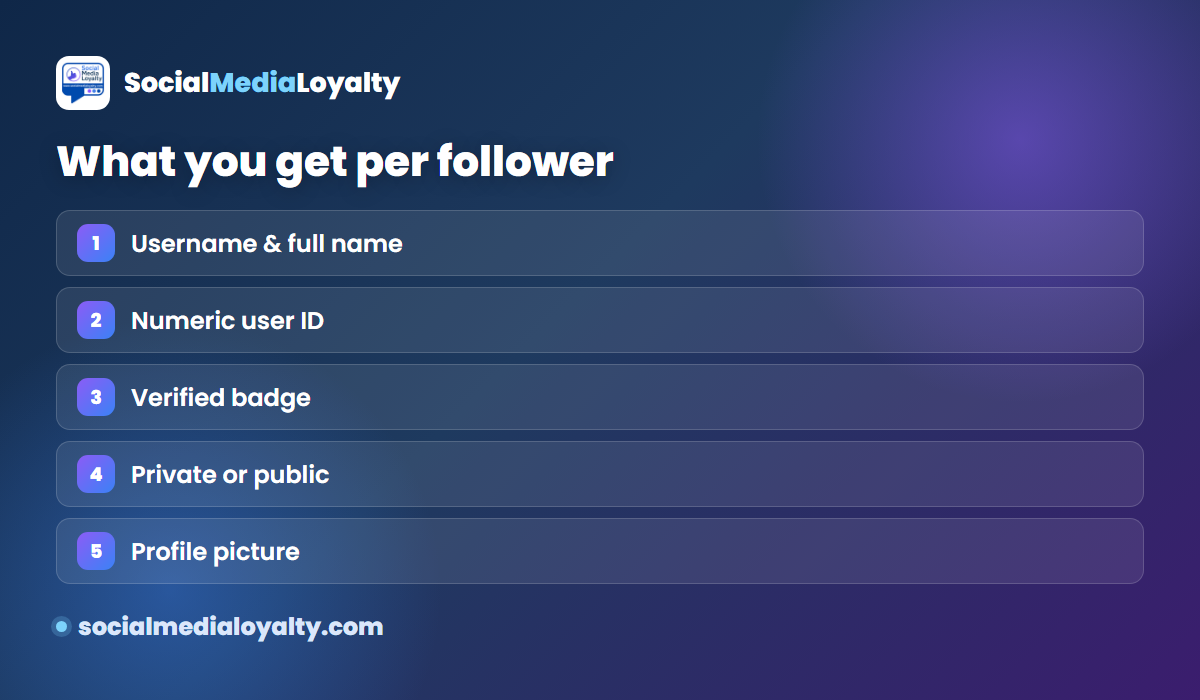
For each user in the list you typically get:
- Username and full name
- Numeric user ID (stable, even if the username changes)
- Verified badge (blue tick or not)
- Private or public account
- Profile picture URL
Followers, likers and commenters
A good followers API covers three related lists: an account's followers, the likers of a specific post, and the commenters on a post (with the comment text). Together they let you see not just who follows a brand, but who actually engages with each post.
What people use it for
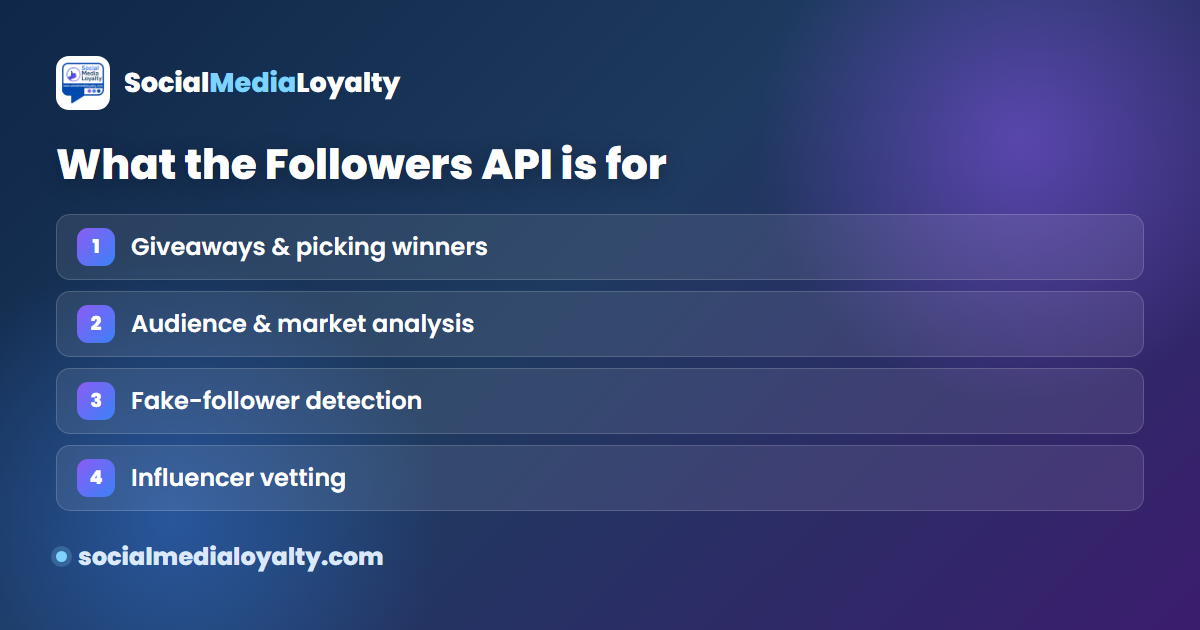
- Giveaways — pull the full list of likers/commenters and pick winners fairly.
- Audience analysis — understand who follows an account and overlap with others.
- Fake-follower detection — spot bot accounts in a follower list (see our guide on detecting fake followers).
- Influencer vetting — check an influencer's real audience before a deal, alongside an account health check.
Why not the official Instagram API?
The official Instagram Graph API only works for business/creator accounts you own, needs a Facebook app and access token, and has heavy limits — it won't hand you an arbitrary public account's follower list. A third-party data API is simpler: it works for any public account and returns plain JSON, with no complex OAuth setup.
How to get started
Our Instagram data API covers followers, likers, comments and more, pay-as-you-go with no monthly cap. For engagement-rate lookups specifically, the Engagement Rate API returns a username's rate and averages directly. Prefer to just check one account? Use the free engagement rate calculator.
How the Instagram Followers API works
- Get an API key. No Facebook app or Instagram login — just a key.
- Send an account or post. Pass a username (for followers) or a post code (for likers/commenters).
- Receive JSON. The list comes back paginated, each user a structured record with the fields above.
- Filter and analyse. Count real vs suspicious accounts, dedupe across posts, or export to a sheet — all downstream of one clean response.
Because it reads public data, it works for any public account without the setup the official Graph API demands. For engagement context on the same account, pair it with the engagement rate benchmarks.
Frequently asked questions
Can I get a list of an account's followers via API?
Yes — for public accounts you can pull the follower list plus post likers and commenters as JSON. Start on the data API page.
What fields does each follower record include?
Username, full name, numeric user ID, verified status, private/public and profile picture. Comment records also include the comment text.
Can I detect fake followers with it?
Yes — the follower records reveal the signals (no photo, missing name, patterns) covered in our fake-follower guide.
Does it work without an Instagram login or token?
Yes. Unlike the official Graph API, our data API works for any public account with a simple key — no Facebook app or OAuth token.
How much does it cost?
Pay-as-you-go with no monthly limit — see current pricing on the API page (Persian: خرید API اینستاگرام).
More from Social Media Loyalty
Instagram engagement tracking
Measure likes, comments and story shares, and build a loyalty leaderboard.
Pricing & order
Simple monthly plans — start tracking one account in minutes.
Blog
More guides and ideas on audience loyalty and engagement.
Campaign leaderboards ↗
See live loyalty leaderboards for real campaigns.
Engagement rate checker ↗
Any public Instagram account's engagement rate, likes and views.